
$8.8 Billion Deal to Slash Development Charges 50% Across Ontario: What It Means for Home Prices
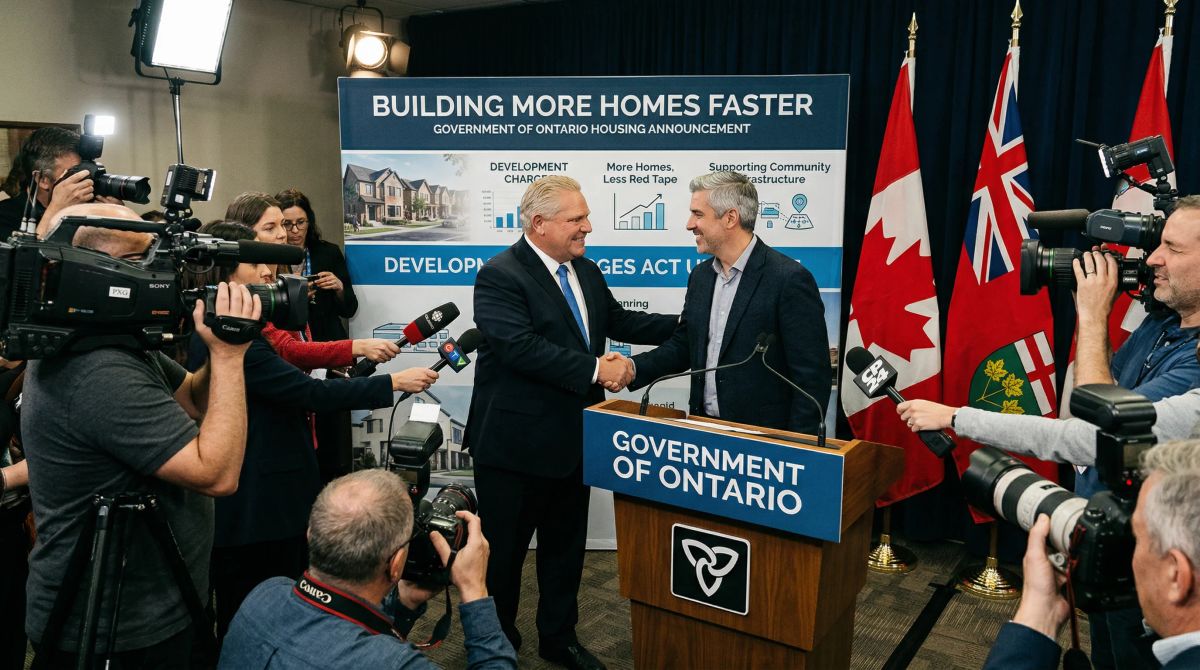
Canada and Ontario just signed an $8.8B deal to cut municipal development charges by 50% for 3 years. Combined with the HST rebate, new homes could drop $200K+.
The Biggest Housing Affordability Deal in Canadian History
On March 30, Prime Minister Mark Carney and Premier Doug Ford stood together in Toronto and signed what both called a "historic" agreement: an $8.8 billion federal-provincial deal to slash municipal development charges by up to 50% across Ontario for three years.
Combined with the $130,000 HST rebate that launched April 1, this deal creates a one-two affordability punch unlike anything the Ontario housing market has ever seen. A new home buyer in Toronto could see total savings exceeding $200,000 -- between eliminated HST, reduced development charges, and existing first-time buyer programs.
The question everyone's asking: will builders actually pass these savings on to buyers?
How the Deal Works
Development charges are fees that municipalities levy on builders to fund infrastructure -- roads, sewers, transit, parks, schools -- needed to support new housing. In the GTA, these charges have become a massive cost driver:
| Municipality | Typical Development Charges (Before Deal) |
|---|---|
| City of Toronto | $80,000 - $120,000+ per unit |
| Mississauga / Brampton | $70,000 - $100,000 |
| Markham / Vaughan | $80,000 - $110,000 |
| Hamilton | $50,000 - $70,000 |
| Durham Region | $40,000 - $60,000 |
Under the deal, the federal government contributes $4.4 billion over 10 years through a new "Build Community Strong Fund," matched by Ontario's $4.4 billion. This funding pays for the infrastructure that development charges were meant to cover, allowing municipalities to cut the charges without losing the ability to build roads and sewers.
The conditions: municipalities must agree to reduce development charges by 50% over three years. Funding is prioritized for municipalities that commit to the largest reductions and those that have already begun cutting DCs.
Toronto Is Already Moving
Mayor Olivia Chow was at the announcement and committed Toronto to significant cuts. The city has already invested over $760 million in DC reductions, including eliminating charges entirely for 6,128 purpose-built rental units, freezing DC rates at 2024 levels, and exempting developments with up to six units from DCs.
"When you see cranes in the sky at construction sites in Toronto, city incentives -- supported by the federal and provincial governments -- made that possible," Chow said.
The announcement also included funding for the Waterfront East Transit line, enabling more than 75,000 new homes in Toronto's eastern waterfront and Port Lands -- one of the largest undeveloped areas in any major North American city.
The Math: Stacking Everything Together
For a first-time buyer purchasing a $900,000 new-build home in Toronto, the combined savings potential is extraordinary:
| Savings Source | Estimated Savings |
|---|---|
| HST rebate (full 13% on $900K) | $117,000 |
| Development charge reduction (50% of ~$100K) | $50,000 (if passed through) |
| Ontario LTT first-time buyer rebate | $4,000 |
| Toronto MLTT first-time buyer rebate | $4,475 |
| Federal first-time home buyer tax credit | $1,500 |
| Total potential savings | $176,975 |
Add the FHSA ($40,000 lifetime) and RRSP HBP ($60,000 per person) for down payment assistance, and a couple could access over $276,000 in combined tax benefits, program savings, and tax-sheltered down payment funds.
The Critical Question: Will Builders Pass It Through?
Here's where healthy skepticism is warranted. Development charges are a builder cost. When they decrease, builders can either pass the savings to buyers through lower prices, keep the savings as profit, or split the difference.
In the current market -- with 20,291 unsold new homes across the GTA and new-build sales 76% below the 10-year average -- builders have strong incentive to pass savings through. They need buyers. Sitting on unsold inventory is expensive. Price reductions that attract sales are preferable to holding inventory and bleeding carrying costs.
But in a recovering market where demand returns and inventory tightens, the calculus changes. Builders facing rising construction costs from tariffs could use DC savings to offset material cost increases rather than reduce prices.
The realistic scenario: buyers will see some but not all of the DC reduction in lower prices. A 50% DC cut of $50,000 might translate into a $25,000-$35,000 price reduction for end buyers, with builders retaining the rest to offset other cost pressures.
Timeline and Implementation
The deal was announced March 30, but implementation requires several steps:
- Municipal councils need to formally adopt the DC reductions
- Infrastructure funding agreements between all three levels of government need to be finalized
- Ontario's legislation enabling the changes may need amendments
- Builders need to update their pricing to reflect lower DCs
Expect the DC reductions to start showing up in new-build pricing over the summer and fall of 2026 as municipalities formalize their commitments and builders adjust. Projects already under construction with locked-in budgets may not see immediate price changes.
What This Means for Resale Buyers
This deal doesn't directly affect resale home prices -- development charges apply only to new construction. But indirectly, lower new-build prices put competitive pressure on resale listings in the same areas. If a new townhouse in Markham drops $50,000 due to lower DCs and HST savings, a comparable resale townhouse nearby needs to compete on price or value.
The resale market could see modest downward pressure on pricing in areas where new construction competes directly with existing homes -- primarily in the 905 suburbs where new developments and established neighbourhoods overlap.
The Bigger Picture
Ontario's housing strategy for 2026 is now fully assembled: the $130,000 HST rebate to stimulate demand, the $8.8 billion DC reduction deal to lower supply-side costs, the $1.3 billion condo-to-rental conversion fund to clear unsold inventory, and $875 million for housing infrastructure.
Whether this massive intervention actually delivers the 8,000+ additional housing starts Ontario projects remains to be seen. The tariff environment, rising construction costs, and economic uncertainty all work against it. But the financial incentive package available to buyers right now is genuinely unprecedented.
If you're in the market for a new-build home in Ontario, the next 12 months offer a window of combined savings that will almost certainly never be replicated at this scale.

Written by
Frank Lee
Market news and data explainers
Market news and data explainers. Writes from public releases (TRREB, CMHC, StatCan, BoC) with original analysis for Ontario / GTA readers.
View all articles by Frank →

