
Construction Costs Finally Stabilizing in Ontario at 2-4% Growth, But Missing Middle Housing Hits Record Lows
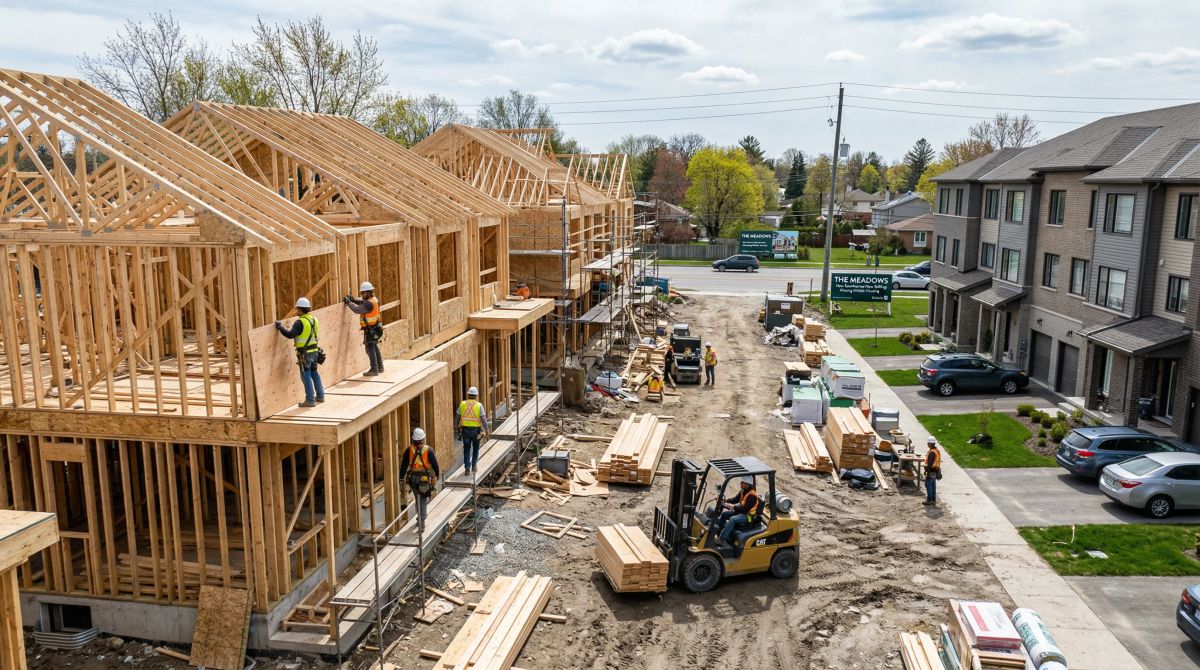
BTY Group reports Ontario construction cost escalation aligning with inflation at 2-4%. But family-sized housing starts hit their lowest January on record since 1990.
Good News and Bad News for Ontario's Housing Pipeline
After years of runaway construction cost inflation, Ontario builders are finally catching a break -- sort of. BTY Group's annual 2026 Construction Cost Report reveals that cost escalation has slowed significantly across most provinces, with Ontario projected at 2-4% growth this year, roughly in line with general inflation. That's a dramatic improvement from the 8-12% annual increases that plagued the sector in 2022 and 2023.
But before anyone celebrates, the Missing Middle Initiative and Rescon dropped a report that should set off alarm bells: ground-oriented housing starts (single-detached, semi-detached, and row houses) in Ontario hit their lowest January on record in 2026 -- just 1,020 units. That's the lowest since tracking began in 1990. And annualized starts are running under 54,000, barely 30% of Ontario's 175,000-unit annual target.
The cost picture is improving. The supply picture is deteriorating. And the gap between what Ontario needs to build and what it's actually building keeps widening.
Where Construction Costs Stand in Ontario
BTY Group's numbers provide the first comprehensive cost benchmarks for Ontario in 2026:
| Building Type | GTA Cost per Square Foot |
|---|---|
| Townhouses | $220 - $375 |
| Low-rise wood-frame (up to 6 storeys) | $225 - $330 |
| Mid-rise concrete (7-15 storeys) | $350 - $450 (estimated) |
| High-rise concrete (16+ storeys) | $450 - $550+ |
Notably, Ontario costs are significantly lower than Vancouver, where the same townhouse costs $280-$430 per square foot and high-rise towers reach $500-$750. For developers considering where to build, Ontario's relative cost advantage is meaningful.
The stabilization is driven by two factors working in opposite directions. On the positive side: demand for construction has dropped, which reduces competitive pressure on labour and materials. On the negative side: that demand drop is because developers can't sell enough units to finance new projects. The cost improvement is a symptom of the demand problem, not a solution to it.
The Tariff Effect: Manageable But Persistent
Cushman & Wakefield's April 2026 analysis estimates that current tariff rates have increased construction material costs by 6.0% relative to 2024 baselines, translating to approximately 3.0% higher total project costs. That's down from a peak estimate of 9.0% when tariffs were at their highest in summer 2025.
The improvement came after the U.S. Supreme Court struck down IEEPA-based tariffs in February, though Section 232 tariffs on steel (25%), aluminum (25%), and lumber remain active. Cushman warns of "persistently restrictive trade policy" creating an environment of "structurally higher costs" that requires recalibration of development feasibility models.
For Ontario specifically, the tariff impact is concentrated in steel-intensive condo construction. Townhouses and low-rise wood-frame buildings are less affected because they rely more on domestically sourced lumber, which has actually seen some price relief as Canadian producers redirect supply away from the tariffed U.S. market.
The Missing Middle Crisis
Here's where the numbers get alarming. The Missing Middle Initiative's analysis of January 2026 data shows:
- Total Ontario starts in January: 4,455 units -- below the 10-year January average of 5,045
- Ground-oriented starts (detached, semi, row): 1,020 units -- the lowest January on record since 1990
- Annualized rate: Under 54,000 -- barely 30% of the 175,000-unit annual target
- Ontario housing starts have fallen every year since 2022
The demand isn't gone -- it's concentrated. BTY Group notes that housing demand "now primarily exists in missing middle-type housing, like townhouses and walk-up apartments." Buyers want these products. The challenge is that falling home prices have created a gap between what homes sell for and what they cost to build.
As the Missing Middle Initiative puts it: "While the price of housing has fallen (a good thing for affordability!), the cost of building new homes has not, so new builds cannot compete with resale." That creates a real risk of a future supply crunch -- when demand returns (whether from economic improvement, lower rates, or resumed immigration), the construction pipeline won't be there to meet it.
The Policy Response Stack
Ontario's government has assembled an aggressive policy response to the supply problem:
| Policy | Target Impact | Status |
|---|---|---|
| HST rebate ($130K max) | Stimulate new-home demand | Active (April 1 - March 2027) |
| $8.8B DC reduction deal | Cut development charges 50% | Announced; municipal implementation pending |
| $1.3B condo-to-rental fund | Convert 2,200 unsold condos | Active, submissions open |
| $875M housing infrastructure | Enable more starts | Budget allocation |
| $83M student housing | 425 units + TMU campus | Budget allocation |
The question is timing. These measures take months to translate into shovels in the ground. The HST rebate should boost new-home sales within weeks. The DC reductions will take longer -- municipalities need to formally adopt the changes, and builders need to reprogram their financial models. The missing middle gap won't close until the economics of building new homes at today's sale prices actually work, which may require further cost reductions, price stabilization, or both.
What This Means for the GTA Market
For buyers right now, the cost story is modestly positive. Construction cost escalation at 2-4% means builder pricing pressure is easing. Combined with the HST rebate and incoming DC reductions, the effective cost of new construction should decline meaningfully in the second half of 2026.
For the medium term (2028-2030), the record-low start numbers are a warning. The homes not being started today are the homes that won't exist in three to five years. When Toronto's housing market eventually recovers -- and every forecaster agrees it will -- the supply crunch could drive the next cycle of rapid price appreciation.
The buyers purchasing now, in a market with elevated inventory and government incentives, may look back and realize they bought during the one window when Ontario's housing market was simultaneously oversupplied with existing homes and under-building the next generation of supply. That's a rare combination -- and it won't last forever.

Written by
Frank Lee
Market news and data explainers
Market news and data explainers. Writes from public releases (TRREB, CMHC, StatCan, BoC) with original analysis for Ontario / GTA readers.
View all articles by Frank →

