
The GTA's Split Market: Condos Down 24.5% While Freehold Homes Barely Budge
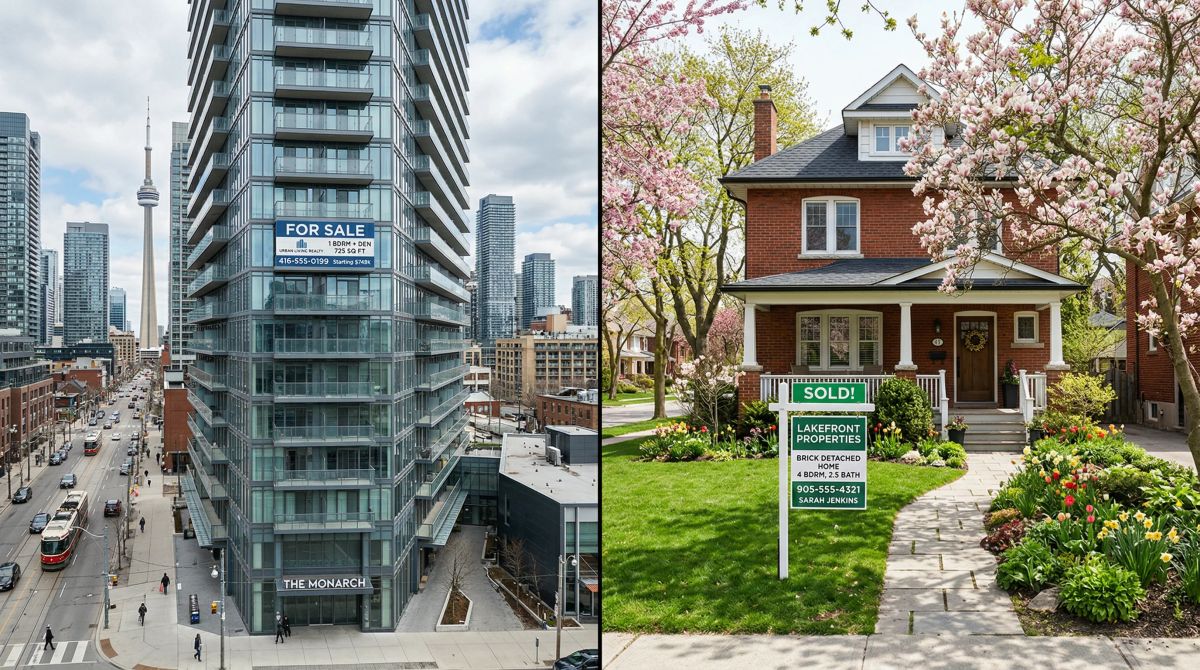
Toronto condos have crashed 24.5% from peak while detached homes are down just 1-2%. Here's why two completely different markets exist under one GTA umbrella.
One Market, Two Realities
The GTA housing market isn't telling one story right now. It's telling two -- and they could hardly be more different.
In one corner: Toronto condos have plummeted 24.5% from their peak. The average city condo sold for $452,200 in February 2026, and nearly 20,000 condo listings are sitting on the market. New condo sales hit levels not seen since 1991.
In the other corner: freehold homes -- detached, semi-detached, and freehold townhouses -- are down just 1-2% year-over-year in the City of Toronto. Multiple offers have returned in some freehold segments. Sellers in established neighbourhoods with good schools are getting close to asking price within reasonable timelines.
The GTA doesn't have a housing market. It has a condo crisis and a freehold market that's quietly stabilizing. Understanding the split is essential for anyone buying, selling, or investing this spring.
The Numbers Tell the Story
| Segment | Avg Price (Feb 2026) | Year-over-Year Change | From Peak | Inventory |
|---|---|---|---|---|
| Toronto condos | $452,200 | -8.9% | -24.5% | ~20,000 listings |
| GTA condos (all) | $626,650 | -8.9% | ~-20% | 14,291 new + resale |
| Toronto detached | Stable | -1 to -2% | ~-15% | Normal-to-elevated |
| Toronto semi-detached | Stable | -1 to -2% | ~-12% | Normal |
| GTA composite (all types) | $938,800 (benchmark) | -7.9% | ~-24% | 17,975+ active |
The composite benchmark masks a reality where freehold homes are doing dramatically better than the headline number suggests. When you strip out condos -- which make up a massive share of GTA transactions -- the freehold picture looks much closer to a stabilizing market than a crashing one.
Why Condos Are Getting Crushed
The condo correction has multiple drivers, and they're all hitting simultaneously:
Investor exodus
Investor-owned condos make up an estimated 55-65% of small downtown units. Many of these investors are facing negative cash flow -- rents dropped 4.7% across Ontario while mortgage payments, condo fees, and property taxes keep climbing. When the math stops working, investors sell. And when a lot of investors sell at once, prices fall.
Supply tsunami
About 28,000 pre-construction condo units are expected to close in 2026. That's on top of the 3,897 completed-but-unsold units developers were already sitting on at the end of 2025. Ontario's new $1.3 billion condo-to-rental fund is absorbing 2,200 of those units, but the supply pressure remains enormous.
Buyer demographics shifted
Immigration cuts and reduced international student enrollment have shrunk the renter pool that sustained condo demand. Canada's population actually declined last year for the first time since Confederation, with most losses in Ontario and B.C. Fewer renters means lower rents, which means worse economics for investors, which means more selling pressure.
Lending tightening
Lenders have become more cautious about condo financing, particularly for smaller units and buildings with high investor ratios. Some banks now require higher down payments for condos in buildings where more than 30% of units are rented out. That narrows the buyer pool further.
Why Freeholds Are Holding Up
The freehold story is almost the mirror opposite:
End-user demand is real
People buying detached homes and townhouses are overwhelmingly buying to live in them, not to invest. End-user demand is driven by life events -- growing families, relocations, divorces, retirements -- that happen regardless of market conditions. These buyers have urgency that investors don't.
New listings dropped sharply
TRREB data shows new listings fell 11.3% year-over-year in February. Many would-be sellers are choosing to wait rather than sell into a soft market, especially if they don't have to move. That supply restraint is keeping freehold inventory manageable even as demand has softened.
Land scarcity is permanent
You can build more condos, but you can't manufacture more land in established Toronto neighbourhoods. The scarcity value of freehold homes in the 416 -- particularly in areas with strong schools, transit access, and walkability -- provides a structural floor that condos don't have.
Mortgage renewals aren't forcing sales
Despite the million-plus mortgage renewals expected this year, TRREB has stated that a surge in distressed selling is "not anticipated." Most freehold homeowners are renewing at rates lower than they expected, thanks to the Bank of Canada's aggressive rate cuts through 2024 and 2025.
What This Means for Buyers in Spring 2026
If you're looking at condos:
You have extraordinary negotiating power. Offers 5-10% below asking are being accepted on condos that have been listed 45+ days. The $130,000 HST rebate on new builds makes the math even more compelling for new condo purchases. But be selective -- building quality, reserve fund health, and fee trajectories matter more than ever. Avoid buildings with high investor ratios and pending special assessments.
If you're looking at freeholds:
The discounts are smaller, the competition is higher, and well-priced homes in desirable areas are still moving within 2-3 weeks. You won't find 24% discounts here, but you will find prices 12-15% below peak with better selection than 2021 or 2022. Don't wait for freehold prices to drop to condo levels -- the dynamics are fundamentally different.
If you're investing:
The split market creates a genuine strategic question. Condos are cheaper but carry more risk (rising fees, regulatory changes, institutional competition from the condo-to-rental fund). Freeholds are more expensive but offer more control, land appreciation potential, and income growth through secondary suites. In 2026, the data points toward freeholds as the more durable investment -- but corrected condos in well-run buildings could offer exceptional value for patient, selective buyers.
Will the Split Persist?
CMHC's 2026 outlook suggests it will. "High resale inventory and weak sales will lead to muted average home prices this year, with a pickup expected in 2027 and 2028." But that pickup will likely be led by freeholds recovering first, with condos lagging as the oversupply works through the system.
The GTA housing market has never been monolithic, but the divergence in 2026 is historically extreme. One market is in crisis. The other is finding a floor. Treating them as one market -- using one GTA benchmark number to make decisions -- is a mistake that could cost buyers and sellers tens of thousands of dollars.
Know which market you're in. Act accordingly.

Written by
Frank Lee
Market news and data explainers
Market news and data explainers. Writes from public releases (TRREB, CMHC, StatCan, BoC) with original analysis for Ontario / GTA readers.
View all articles by Frank →

