Ontario's Two-Speed Market: Condos Sink, Detached Holds
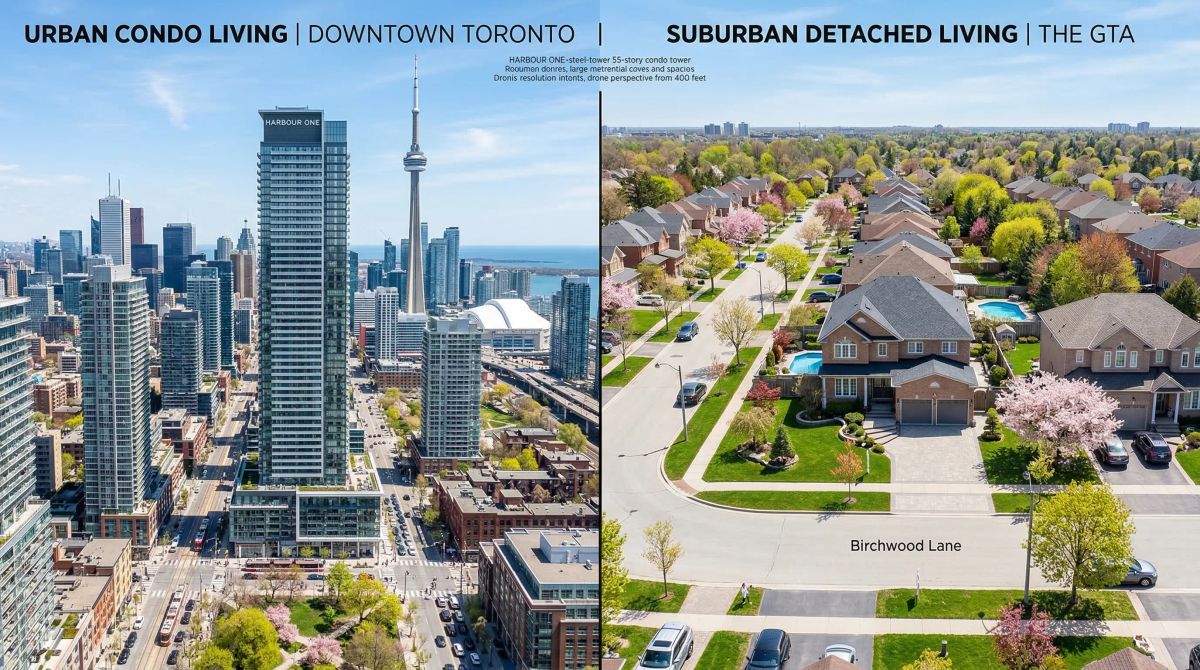
Toronto condos have dropped while suburban detached homes hold steady. Here's why Ontario's housing market split in two and what it means for your next move.
Ontario's housing market has stopped moving as one. What you're watching unfold in 2026 is a genuine split — a market where the type of property you own or are buying matters more than it has in years. Condos and detached homes are moving in different directions, driven by different forces, and the gap between them is wider than it's been in recent memory.
The Ontario condo market 2026 story is one of oversupply, investor exit, and negative cash flow. The detached home story is one of constrained inventory, durable family demand, and relative price stability. Understanding the distinction isn't academic — it's the difference between buying into a headwind and buying into a tailwind.
The Data: What's Actually Happening
The national housing picture looked soft heading into spring 2026. The MLS® Home Price Index fell 0.6% month-over-month in February 2026 and was down 4.8% year-over-year, according to the Canadian Real Estate Association. National home sales dipped 1.3% in February after falling 5.8% in January — well below historical norms.
CREA's senior economist Shaun Cathcart noted: "2026 is still ultimately expected to be a story about pent-up first-time buyer demand finally seeing a chance to enter the market. They've had to wait a long time for mortgage rates to find a bottom, but some will no doubt continue to hold off for a bottom in prices in some Ontario and British Columbia markets."
But that national average obscures a major divergence. Within Ontario — and within Toronto specifically — the condo and detached markets are telling completely different stories.
The GTA Numbers in Detail
GTA REALTORS® reported 3,868 home sales in February 2026 — down 6.3% compared to February 2025. The MLS® HPI Composite benchmark was down 7.9% year-over-year. The average selling price was $1,008,968 — down 7.1% from February 2025.
But within those averages, condos are dragging everything down. TRREB's 2026 Market Outlook forecasts a GTA average price range of $1 million to $1.03 million, noting that "elevated inventory levels across most market segments are expected to continue providing buyers with substantial negotiating power, particularly in the condominium apartment market." That phrase — particularly in condos — is doing a lot of work.
Why the Condo Market Is Under Pressure
Investor Exit
Ontario's condo market was built on investor demand. Through the 2010s and into the early 2020s, pre-construction condos sold almost instantly, often to investors banking on appreciation. Those investors are now trying to exit — and they're discovering that the market has moved against them.
The math is brutal. A one-bedroom condo purchased for $600,000 in 2021 with 20% down ($120,000) and a 5-year fixed mortgage at today's rates (roughly 4.5%) carries a monthly mortgage payment of about $2,650. Add condo fees ($600–$800), property taxes ($350), and maintenance reserves — you're at $3,800–$4,000/month in carrying costs. Rental rates for comparable units in many GTA buildings are $2,400–$2,800/month. That's cash flow negative by $1,000–$1,600/month. Every month.
When investors are losing money every month and prices aren't rising to compensate, the rational decision is to sell. Many are making exactly that decision simultaneously. The result: elevated condo supply, depressed condo prices, and few institutional buyers willing to absorb the surplus.
Pre-Construction Sales at Multi-Decade Lows
The problem runs deeper than resale. Ontario's overall housing starts are projected to fall to near two-decade lows in 2026, driven by very low condominium pre-construction sales, according to CMHC's Housing Market Outlook. Developers need a certain percentage of units pre-sold before banks will finance construction. Without those pre-sales, projects get shelved or cancelled.
CMHC expects more condominium projects to be postponed or cancelled in 2026, with effects extending into 2027 and 2028. This is a long-cycle problem: the condos not being built today are the condos that won't hit the market in 2027–2029, which eventually tightens supply — but that's years away, and it doesn't help current condo holders.
Condo Valuations Down from Peak
Toronto condo prices have fallen meaningfully from their 2022 peak. Toronto condos gained 63.6% from 2016 to 2026 according to Zoocasa analysis, but that long-term appreciation figure masks the fact that most of the gain happened before 2022. Anyone who bought at peak prices is sitting on losses or barely breakeven, and the prospect of another year of flat-to-declining prices is accelerating the exit.
Downtown Toronto is particularly soft. Comments from analysts cited in a YouTube housing market breakdown tracked expectations of "2–4% average declines in the GTA with pockets of downtown Toronto down even more." If you're in a building with high investor concentration, count on above-average softness.
Why Detached Homes Are Holding Their Ground
Supply Remains Constrained
The detached home market in Ontario's suburbs and secondary cities doesn't have a supply surplus problem. Homeowners who bought detached homes in 2018–2021 at 2–3% mortgage rates are sitting on those properties — locked in by the rate differential. Trading into a new home at today's rates means trading a 2.5% rate for a 4.5% rate on a much larger mortgage. Many simply don't move.
That lock-in effect keeps supply low. With fewer homes hitting the market, competition among the buyers who do enter remains reasonable. Prices don't crash when supply is constrained.
Family Demand Remains Structural
Ontario's population is growing. Immigration targets, while moderated from the 2023–2024 peaks, still represent net new demand for housing. Families want ground-floor space, backyards, and school catchment areas. They're not buying condos. The demand pool for detached homes is both larger and more durable than the investor-dominated demand pool that drove condo growth.
TRREB notes "substantial pent-up demand in the GTA ownership market, with more than 100,000 buyers holding off on making a home purchase," waiting for prices and rates to stabilize. When that demand moves — likely in the second half of 2026 or into 2027 — detached homes and townhouses in desirable neighbourhoods will feel it first.
Secondary Cities Outperforming Toronto
The two-speed market isn't just condos versus detached — it's also Toronto versus everywhere else. CREA noted that cities like St. John's, Regina, and Quebec City were seeing significant price increases while larger urban centres stagnated. Within Ontario, smaller markets with strong fundamentals — employment, population growth, lifestyle appeal — are showing more resilience than the GTA core.
Condo vs. Detached: The Key Metrics Compared
| Metric | GTA Condo | Detached/Semi (Suburbs) |
|---|---|---|
| Price trend (YoY, Feb 2026) | -10% to -14% in many buildings | -4% to -7% (more stable) |
| MLS® HPI Composite YoY | Dragging index down | Closer to -5% |
| Active inventory | Elevated — significant surplus | Below long-term average |
| Days on market | 60-90+ in many buildings | 30-45 days typical |
| Investor cash flow | Negative $800–$1,600/month | Varies; less acute problem |
| Pre-construction pipeline | Near multi-decade lows | Modest; some townhouse starts |
| TRREB price forecast (2026) | Continued pressure | $1M–$1.03M avg (more stable) |
| End-user demand base | Primarily investor-dependent | Strong family/owner-occupant |
What This Means for Buyers in 2026
If you're a first-time buyer looking for a condo as an affordable entry point, the current market offers genuine opportunity — but choose carefully. A building with high investor concentration is more exposed to further price pressure and potential special assessments from deferred maintenance. A well-run building in a walkable neighbourhood with strong rental demand is a different story.
For investors, the condo market is a value trap until cash flow math improves — either through lower purchase prices, higher rents, or lower mortgage rates. None of those conditions are imminent in the GTA. Patience is required.
For buyers shopping detached and semi-detached in the $800,000–$1.3 million range in the suburbs, the market is softer than 2022 but not in freefall. Inventory has improved, but it hasn't flooded. Buyers have real negotiating power on conditions and closing dates without necessarily chasing prices lower. CMHC expects Ontario prices to keep falling modestly in 2026 before stabilizing and recovering in 2027 — so this window of relative affordability and buyer leverage is real, but it won't last indefinitely.
The Outlook
Ontario's two-speed market is likely to persist through 2026. The structural issues in the condo segment — investor exit, negative cash flow, muted pre-construction activity — don't resolve quickly. The detached segment's relative stability reflects genuine supply constraints and structural demand that isn't going anywhere.
What changes the condo picture? Sustained rental rate increases (possible but not guaranteed), lower financing costs (Bank of Canada is on hold at 2.25%), and time — enough of it for the investor overhang to clear. Don't count on a condo recovery before late 2026 at the earliest. Plan for 2027–2028 if you're holding or considering buying.

Written by
Frank Lee
Market news and data explainers
Market news and data explainers. Writes from public releases (TRREB, CMHC, StatCan, BoC) with original analysis for Ontario / GTA readers.
View all articles by Frank →