
Toronto Housing Starts Crash 28% as Tariff Uncertainty Halts New Construction
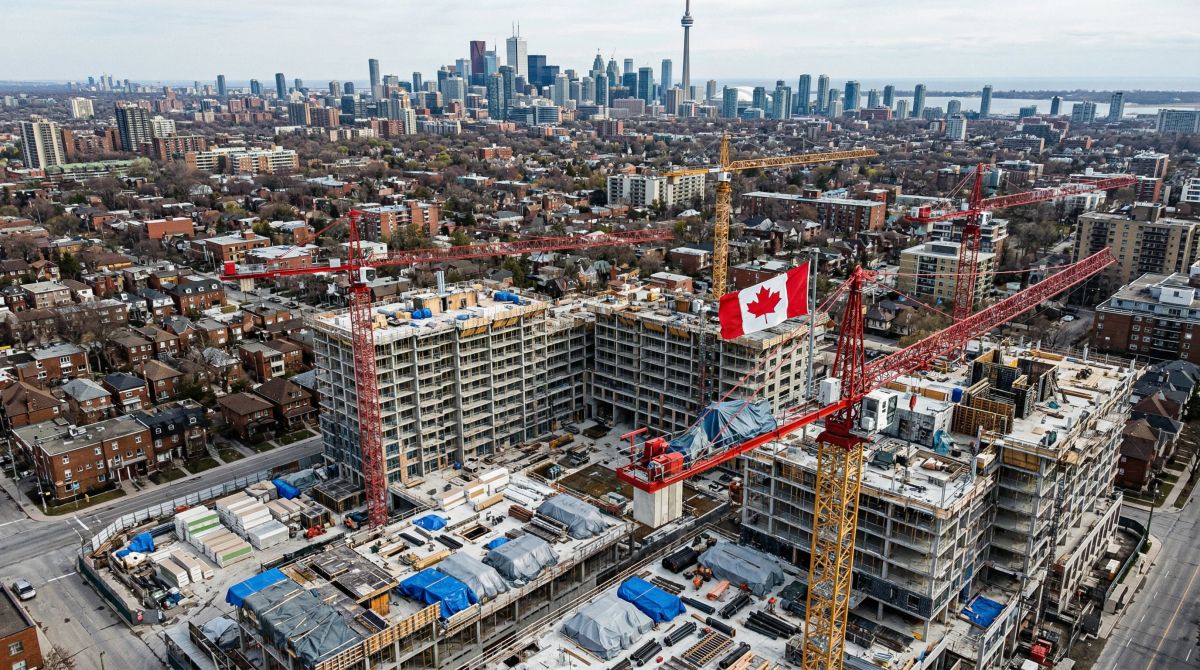
Toronto posted a 28% year-over-year decline in housing starts in February while the rest of Canada rose 10%. Tariff fears and a condo presale collapse are stalling supply.
Building While the Rest of Canada Builds More
Toronto is moving in the opposite direction from almost every other Canadian city when it comes to new home construction. CMHC's February 2026 data, released in March, showed housing starts in Toronto declined 28% year-over-year -- a stark contrast to Montreal's 18% increase and Vancouver's explosive 60% jump. At the national level, actual housing starts rose 10% year-over-year to 15,886 units across all major centres.
This isn't a new problem, but the divergence is getting worse. Toronto's starts have now fallen well below the historical average and, according to CMHC's Spring 2026 Housing Supply Report, sit at the lowest per-capita level among Canada's seven largest census metropolitan areas. Calgary, Montreal, and Vancouver have all surpassed Toronto -- a city that, not long ago, was the country's undisputed construction leader.
What's Causing the Collapse in Toronto Starts
Multiple forces are compressing new construction simultaneously:
The Condo Presale Implosion
Toronto's new construction machine runs on pre-sales. Developers need 50-70% of units pre-sold before they can secure construction financing. When buyers stop committing to pre-construction condos -- as they have, dramatically, since 2023 -- the pipeline dries up.
CMHC describes it bluntly: "Condominium presales collapsed, unsold inventory surged and financial conditions tightened." The Spring Supply Report notes "record condominium project cancellations" that will remove thousands of units from future delivery. And those cancellations are showing up right now in the start numbers.
Tariff-Driven Cost Uncertainty
The U.S.-Canada trade war has introduced a level of material cost uncertainty that makes project economics nearly impossible to model. Lumber duties at approximately 40%, steel tariffs at 25%, and potential retaliatory tariffs on U.S.-sourced building materials all feed into wildly uncertain construction cost projections.
Developers can't price units for sale in 2027 or 2028 when they can't reliably project what it will cost to build them. CMHC warned explicitly that "heightened levels of business uncertainty and construction costs" are expected to "weigh on the rate and trend of housing starts in the near-to-medium term." Near-to-medium term is already happening.
Investor Retreat from Condo Purchases
In Toronto, investor demand has historically driven pre-construction condo sales -- often 55-65% of units in small downtown buildings go to investors. When rents fall (Ontario rents dropped 4.7% year-over-year) and mortgage rates stay elevated relative to rental income, the investor math stops working. Without investors buying pre-construction, developers can't reach their presale thresholds, and projects don't get financed.
The Numbers in Context
| City | Housing Starts (Feb 2026 YoY) |
|---|---|
| Toronto | -28% |
| Montreal | +18% |
| Vancouver | +60% |
| National (all centres) | +10% |
Year-to-date through February, national starts are up 5% -- but that's largely driven by British Columbia and Ontario outside of Toronto. Higher activity across the rest of Ontario has partially offset Toronto's declines.
The Silver Lining: Rental Construction Is Filling the Gap
There's one bright spot hidden in the supply data. Purpose-built rental starts have been strong enough to offset some of the condo collapse. In the City of Toronto specifically, rental unit starts exceeded condo apartment starts in 2025 for the first time -- ever. That's a structural shift driven by government programs (including the federal CMHC low-cost loans for purpose-built rental), transit-oriented development initiatives, and projects that were approved under lower borrowing costs in 2021-2023 that are now completing.
The Spring Supply Report also highlights that buildings with 3 to 5 units surpassed those with 100+ units for the first time, and that "missing middle" construction -- rows, townhouses, and low-rise conversions -- made up roughly 40% of Toronto starts, with more than half coming from building conversions.
So while the condo pipeline is in crisis, the shape of what's being built is actually changing in useful ways. The problem is quantity: total units started are still far below what's needed.
What This Means for GTA Buyers and Sellers
The paradox of Toronto's housing market is crystallizing. Right now, there's too much supply of condos and not enough demand. But the supply pipeline for the medium term (2027-2030) is being severely damaged by today's start collapse. When demand returns -- and every forecaster, from CMHC to TD Economics to Royal LePage, expects a recovery in 2027 -- there may not be enough new supply to meet it.
That dynamic has historically driven the type of sharp price recoveries Toronto has seen after every past downturn. Agents who experienced 1996-2000 and 2009-2012 know what happens when pent-up demand finally collides with constrained supply.
For buyers making decisions today:
- A 28% start decline means fewer completed units entering the market in 2028-2029 than would otherwise exist
- Properties with genuine rental income potential (secondary suites, duplex conversions) become more valuable as rental construction can't keep pace with population needs long-term
- The current inventory surplus, particularly in condos, could reverse faster than expected if economic conditions stabilize and demand returns
For the Ontario government's housing ambitions, the start data is a genuine problem. The $130,000 HST rebate was designed to stimulate demand and pull forward housing starts. Its success will be measurable in CMHC's next monthly release on April 17 -- the first data set covering the post-rebate period.
Until then, Toronto remains the outlier: a city with too many finished condos sitting unsold, and nowhere near enough homes being started to meet the housing needs of the next decade.

Written by
Frank Lee
Market news and data explainers
Market news and data explainers. Writes from public releases (TRREB, CMHC, StatCan, BoC) with original analysis for Ontario / GTA readers.
View all articles by Frank →

