
Trade War Fallout: Ontario Housing Caught Between Recession Fears and $130K HST Savings
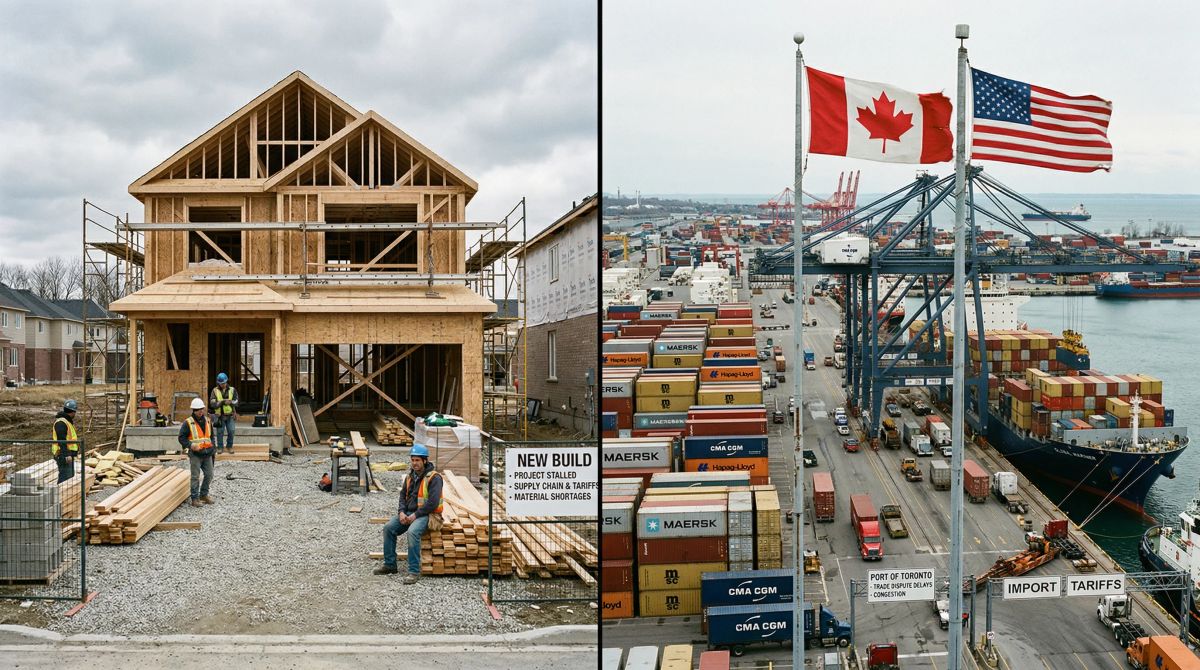
With 25% tariffs still in effect, CMHC warning of recession, and Ontario housing starts at decade lows, the $130K HST rebate faces its biggest test yet.
Two Forces Pulling in Opposite Directions
Ontario's housing market is caught in a tug-of-war that's unlike anything we've seen before. On one side: the most generous new-home tax break in provincial history, with the $130,000 HST rebate now in its third day. On the other: a trade war that's already shaved 1.5-2% off Canada's GDP, triggered warnings of a possible recession, and is keeping over 100,000 GTA buyers frozen on the sidelines.
The question this spring isn't just whether buyers will take advantage of the HST savings. It's whether the broader economy will hold together long enough for them to do it.
Where the Trade War Stands Today
The tariff picture remains chaotic. Here's what Ontario's housing market is dealing with:
| Tariff | Status | Housing Impact |
|---|---|---|
| 25% U.S. tariff on Canadian goods (non-USMCA) | Active since early 2025 | Broad economic damage, job uncertainty, buyer hesitation |
| 25% on Canadian auto imports | Active | Direct threat to Ontario's manufacturing belt (Windsor to Oshawa) |
| ~40% effective duty on softwood lumber | Active (25% tariff + 14.5% existing duties) | Higher construction costs for wood-frame homes |
| 25% on steel and aluminum | Active globally | Higher costs for structural steel, rebar, condo construction |
| Canada's retaliatory tariffs on U.S. goods | Some removed Sept 2025, some remain | Higher costs for U.S.-sourced building materials (windows, cement, appliances) |
Canada removed roughly $44 billion in retaliatory tariffs in September 2025 to stabilize trade relations. But the core U.S. tariffs on Canadian goods remain in place, and Trump's January 2026 threat of 100% tariffs on all Canadian imports if Canada proceeds with its China trade deal continues to loom.
Economists estimate Canadian households are absorbing $1,700-$2,000 in higher annual costs from the tariff cycle. That's money that's not going toward mortgage payments or down payment savings.
CMHC's Warning: "Subdued" Is the Operative Word
CMHC's 2026 Housing Market Outlook, released in February, didn't mince words. Demand from buyers is expected to "remain below historical averages." The agency pointed to three converging headwinds:
- Elevated price-to-income ratios keeping homes unaffordable for many
- High carrying costs despite lower mortgage rates
- Lingering job uncertainty from the trade war, especially in aluminum, steel, lumber, autos, and parts manufacturing
The word "recession" appeared in CMHC's analysis, and it's not theoretical. Oxford Economics warned as early as November 2025 that Canada could face a recession if tariffs aren't resolved. The GDP contraction estimates in a severe scenario range from 3-5%, with unemployment potentially hitting 10-12%.
That's the backdrop against which the Ontario government is asking people to sign purchase agreements for new homes.
Ontario's Numbers Paint a Complicated Picture
The province's own budget acknowledged the damage. Resales dropped 5.6% in 2025, prices fell 4.4%, and housing starts are projected at just 64,800 for 2026 -- down from an earlier forecast of 74,800, and nowhere near the pace needed to reach the government's 1.5 million homes by 2031 target.
Finance Minister Peter Bethlenfalvy has effectively abandoned that target: "No, no, I'm not focused on the target. I'm focused on what we can do today to make it more affordable for people to own homes."
But the budget does project a resale rebound: 9.1% growth in 2026. That optimism depends heavily on "pent-up demand and economic growth" -- both of which are threatened by the trade war.
The Regional Vulnerability Map
Ontario isn't uniformly affected. The regions most exposed to trade war damage are also some of the most important housing markets:
- Southwestern Ontario (Windsor, Kitchener-Cambridge-Waterloo, Guelph): Automotive and manufacturing heartland. A 25% tariff on vehicles and parts directly threatens employment here. Housing analysts have warned of 20-30% price declines in a severe scenario.
- Hamilton: Canada's steel centre, directly exposed to 25% steel tariffs.
- Oshawa: GM's Canadian operations face tariff uncertainty. This is the most affordable GTA suburb, but its economic base is vulnerable.
- Greater Toronto core: Less directly exposed to tariffs, but buyer confidence is the issue. RE/MAX Canada's Don Kottick noted that trade uncertainty kept the market "in a holding pattern" through 2025, with buyers staying on the sidelines.
Bank of Canada: Holding Steady, Watching Closely
The Bank of Canada held its overnight rate at 2.25% on March 18 -- the third consecutive hold. The next decision is April 29.
Markets are pricing in a 97.5% probability of no change at the April meeting. Nearly 75% of economists surveyed by Reuters expect rates to hold through all of 2026, up from 60% who expected that in December. The consensus is that the bank is sitting at the bottom of its neutral range and waiting to see how the trade situation unfolds before making any further moves.
For mortgage holders, this means stability: the best 5-year variable rate remains at 3.35%, and fixed rates around 3.94%. But "stable" isn't the same as "helpful" -- rates would need to drop further to meaningfully boost affordability, and the trade war is making that less likely, not more.
What This Means for Buyers Right Now
The honest assessment: the HST rebate is a genuine and significant savings opportunity. But it exists in an environment of elevated risk.
Buyers who should act this spring:
- Those with stable employment in sectors not exposed to tariff risk (healthcare, education, government, technology)
- Those who've already saved a substantial down payment and can weather a price decline
- Those planning to hold the property for 7+ years, long enough to ride through any economic turbulence
Buyers who should wait:
- Those working in manufacturing, automotive, steel, or trade-exposed industries where job security is uncertain
- Those stretching to the absolute maximum of their qualification, with no financial buffer
- Those expecting prices to bottom in the next 3-6 months -- the bottom may not arrive until trade uncertainty resolves
The HST rebate runs until March 2027. There's no rush. Take the savings when you're ready -- not when the market pressure tells you to.

Written by
Frank Lee
Market news and data explainers
Market news and data explainers. Writes from public releases (TRREB, CMHC, StatCan, BoC) with original analysis for Ontario / GTA readers.
View all articles by Frank →

