Buying a Home in Ontario This Spring? Your Complete 2026 Readiness Checklist
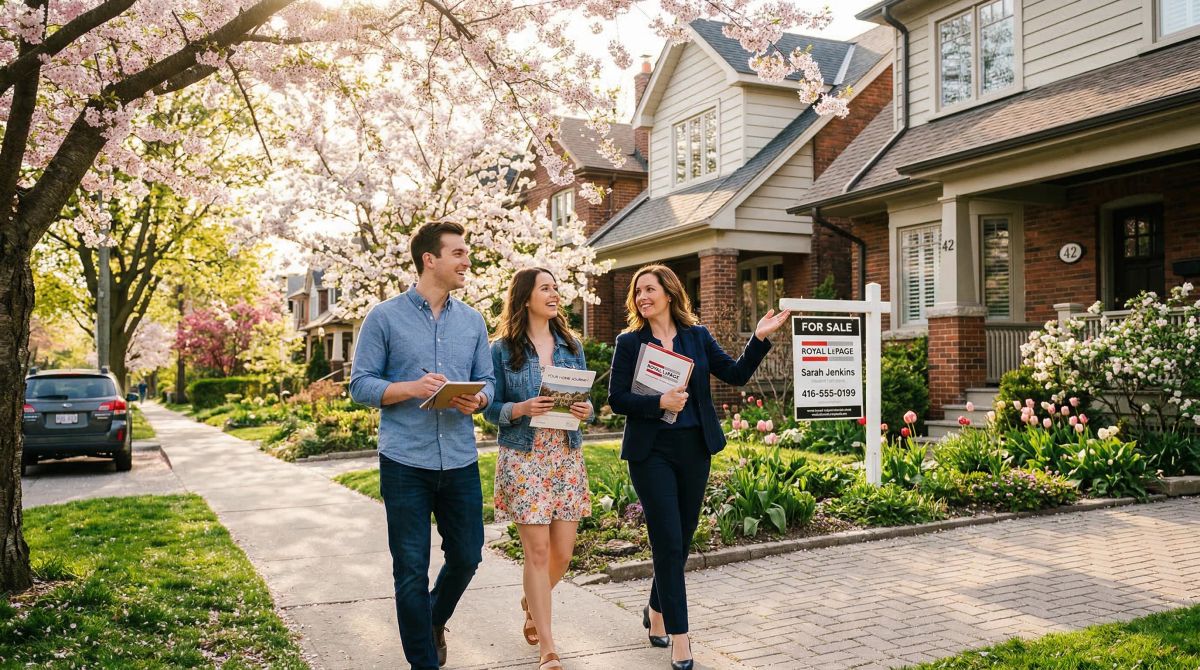
Buying a home in Ontario spring 2026 means navigating stress tests, bidding wars, and new buyer protections. This 10-step checklist covers everything you need.
Spring 2026 Is Different — Here's What You Need to Know
Buying a home in Ontario this spring isn't the same as it was two years ago, and it's not the same as it was six months ago either. The GTA recorded 3,868 sales in February 2026, up 25.5% from January, and average prices climbed back above the $1 million mark after briefly dipping below it. New listings are down roughly 18% year-over-year. In pockets of the city — particularly in the $800,000 to $1.4 million detached range — well-priced homes are drawing multiple offers again.
That doesn't mean the market is frothy. Months of supply sat at 5.0 in February, which technically still qualifies as a buyer's market. But the trend is moving. If you're thinking about buying a home in Ontario this spring, you need to be prepared before you start viewing properties — not after you find the one you want. This checklist walks through every step in order.
Step 1: Get Your Mortgage Pre-Approval — the Real One
There's a difference between a pre-qualification and a full pre-approval, and it matters. A pre-approval involves a lender actually pulling your credit and verifying your income documents. In a competitive offer situation, sellers and their agents can tell the difference, and a proper pre-approval carries more weight.
In Canada, every mortgage applicant is stress-tested at the higher of either 5.25% or your actual contract rate plus 2%. If you're being offered a 4.5% fixed rate, you're tested at 6.5%. This determines your maximum approved amount. The federal stress test also uses gross debt service (GDS) ratios capped at 39% and total debt service (TDS) ratios capped at 44%. Your GDS includes your mortgage payment, property taxes, heat, and 50% of condo fees — all divided by your gross monthly income. TDS adds all your other debt payments (car loans, student loans, credit cards) to that calculation.
Know both numbers before you go shopping. Your pre-approval amount is your ceiling — not your target.
Step 2: Calculate Your REAL Budget
The bank will tell you what you can borrow. Nobody will tell you what you can actually afford — that's your job. A $1 million home doesn't just cost a mortgage payment. It costs property tax (roughly $6,000 to $9,000 per year for a $1M GTA home), home insurance ($1,500 to $2,500 annually), and maintenance. The rule of thumb for maintenance is 1% of the home's value per year — so a $1 million property should have $10,000 budgeted annually for repairs, appliances, and upkeep. Over the course of a decade, that adds up to $100,000 or more.
Add in utilities, any condo fees if applicable, and your lifestyle costs — and build a monthly budget that reflects what you'll actually spend, not what looks good on a mortgage application. Buyers who stretch to the maximum of their pre-approval often end up house-poor, unable to afford anything beyond the mortgage payment. That's a miserable way to own a home.
Step 3: Open a First Home Savings Account (FHSA) Now
If you haven't already opened a First Home Savings Account and you're a first-time buyer, do it this week. The FHSA lets you contribute $8,000 per year up to a $40,000 lifetime limit. Contributions are tax-deductible — like an RRSP — and withdrawals for a qualifying home purchase are completely tax-free, including all the investment growth inside the account. That's the best of both worlds, and there's no other savings vehicle in Canada that matches it for first-time buyers.
The one catch: you need to have the account open for at least one calendar year before you can make a qualifying withdrawal. If you open it today, March 2026, you can contribute $8,000 for 2026 and withdraw it (along with contributions made in future years) after January 1, 2027. Any year you don't open the account is a year of contribution room you lose permanently.
Step 4: Understand the Home Buyers' Plan
The Home Buyers' Plan (HBP) lets you withdraw up to $60,000 per person — $120,000 for a couple — from your RRSP tax-free for a first home purchase. You have 15 years to repay the funds back into your RRSP, starting two years after the withdrawal year, with minimum annual repayments of one-fifteenth of the total amount withdrawn.
The HBP and FHSA can be used together. A couple who've both been saving for a few years could potentially combine FHSA withdrawals with HBP withdrawals to assemble a substantial down payment. Run the numbers with a financial planner or mortgage broker before you decide — the optimal strategy depends on your tax situation and how much RRSP room you have.
Step 5: Research Neighbourhoods Like a Data Analyst
"Location, location, location" gets said so often it's lost its meaning. What it actually means in practice is doing specific research on commute times, school catchment areas, transit access, development pipeline, and long-term growth signals before you fall in love with a property.
Check transit expansion plans for the areas you're considering. In the GTA, new Metrolinx lines and subway extensions have historically driven significant property value appreciation in adjacent neighbourhoods — often before the construction is even complete. Look at what's been approved for development nearby; a low-rise neighbourhood that's been zoned for higher density is going to look very different in 10 years.
Walk or drive neighbourhoods at different times of day. Visit on a weekday morning and a Saturday afternoon. Talk to people who live there. No amount of online research replaces the ground-level experience of actually spending time in a neighbourhood before you commit to it.
Step 6: Know What You're Actually Buying
The property type you choose has major implications for your lifestyle, your budget, and your future resale. Here's where GTA prices landed by property type in February 2026, according to WOWA data:
Detached homes: average $1,325,654. Maximum privacy, no shared walls, typically larger lots. The tradeoff is price — you're buying a lot of space you may not need, and maintenance costs scale accordingly.
Semi-detached: average $1,027,376. One shared wall, usually a driveway on your own side, still no condo fees. Good middle ground for families who want ground-level access without the full detached price tag.
Freehold townhouses: average $930,779. Multiple floors, no condo corporation, small outdoor space. Popular with young families who want freehold without the detached price.
Condo townhouses: average $748,500. Similar layout to freehold but with condo fees and a corporation governing common elements. More maintenance included, less control.
Condo apartments: average $626,650. The lowest entry point into ownership, but comes with monthly fees, potential special assessments, and less control over your living environment. The resale condo segment is currently soft — which means buying opportunity, but also means being careful about projects with large reserve fund shortfalls.
Each property type has trade-offs. Be honest about what your day-to-day life actually looks like — how many cars you have, whether you have kids or plan to, how much outdoor space matters, and how comfortable you are with shared governance — before you decide.
Step 7: Budget Properly for Closing Costs
New buyers consistently underestimate closing costs. Budget 3-5% of the purchase price beyond your down payment to cover:
Land Transfer Tax (LTT): Ontario charges LTT on a sliding scale — 0.5% on the first $55,000, 1% up to $250,000, 1.5% up to $400,000, 2% above that, and 2.5% on the portion above $2 million for residential properties. Toronto buyers pay a second municipal LTT on top of the provincial one. On a $900,000 purchase in Toronto, combined LTT can run approximately $28,000 to $30,000.
First-time buyer rebates: Ontario offers an LTT rebate of up to $4,000 for first-time buyers. Toronto's municipal rebate adds up to $4,475. These are applied at closing and reduce your net LTT significantly.
Legal fees: Expect $1,500 to $2,500 for a real estate lawyer.
Title insurance: Typically $200 to $400 for a residential property.
Home inspection: $400 to $600. Always worth it, even in competitive markets — more on that below.
Adjustments: Property tax and utility adjustments to settle with the seller on closing day.
Moving costs and immediate repairs: Budget at least a few thousand dollars for the inevitable items that need attention in the first 30 days.
Step 8: Choose the Right Agent — Then Actually Let Them Work
Interview at least two or three buyer's agents before committing to one. Ask specifically about their experience in your target neighbourhoods, their average list-to-sale ratio for buyers they've represented, and how they handle multiple-offer situations. Ask how many transactions they've completed in the past 12 months. An agent who does 3 deals a year has a very different skill set than one who does 30.
Under TRESA (Trust in Real Estate Services Act), written buyer representation agreements are now mandatory in Ontario before an agent can show you a property. This formalizes the agency relationship and spells out what your agent is obligated to do for you. Read the agreement carefully and make sure you understand the terms, including the duration and any exclusivity provisions.
A good agent isn't just a door-opener. They should be monitoring new listings in your target areas before they hit the public portals, running comparable sales analyses for every property you're seriously considering, and giving you honest advice about when a home is overpriced — even if it's the one you want.
Step 9: Know Your Rights Under TRESA
TRESA brought significant changes to how real estate transactions work in Ontario, and buyers who don't know their rights are at a disadvantage. Written buyer representation agreements are now mandatory, and agents are required to provide clear disclosure when they're representing multiple parties in a transaction (multiple representation).
TRESA also strengthened the disclosure requirements around property conditions and known issues. Your agent is required to disclose information that could affect your decision to purchase — and that obligation runs to you, not to the seller or their agent. If you're unsure about what's been disclosed or not disclosed in a particular transaction, ask your lawyer to review the documentation before you go firm.
The new rules also affect how open bidding works. Sellers can now choose to disclose competing offer prices and details to other bidders — a significant change from the traditional sealed-envelope model. Not all sellers will opt in, but it's worth understanding the options before you find yourself in a bidding situation.
Step 10: Prepare for Bidding Wars — Strategically
Some properties in the $800,000 to $1.4 million freehold range are drawing multiple offers right now, particularly in well-established neighbourhoods with strong school rankings and transit access. If you find yourself in that segment, you need to be prepared before you write an offer — not after you've fallen in love with the property.
Have your deposit ready. In most GTA transactions, the deposit is due within 24 hours of acceptance and typically runs 5% of the purchase price. Know where those funds are sitting and make sure they're accessible immediately — a bank draft takes time to arrange, and scrambling after an accepted offer is stressful and avoidable.
Talk to your lawyer before you waive a home inspection condition. In some competitive situations, buyers are choosing to do a pre-offer inspection — hiring an inspector to walk the property before offers are submitted — to allow them to bid without a condition. This has costs and risks that your lawyer should explain. Never waive conditions without understanding exactly what you're giving up and having professional guidance on the decision.
The spring of 2026 won't be a repeat of 2021. But in specific segments and specific neighbourhoods, the buyers who've done their homework will move faster, bid more confidently, and close successfully — while the ones who skipped steps 1 through 9 are still scrambling to get pre-approved after finding the house they want.
Do the work now. The market won't wait.

Written by
Sara Shao
Contributing writer
Contributing writer on buyer, career, and market explainers published on RealEstateHQ.
View all articles by Sara →