
Rent vs. Buy in Ontario 2026: Why Falling Rents Make the Math Trickier Than You Think
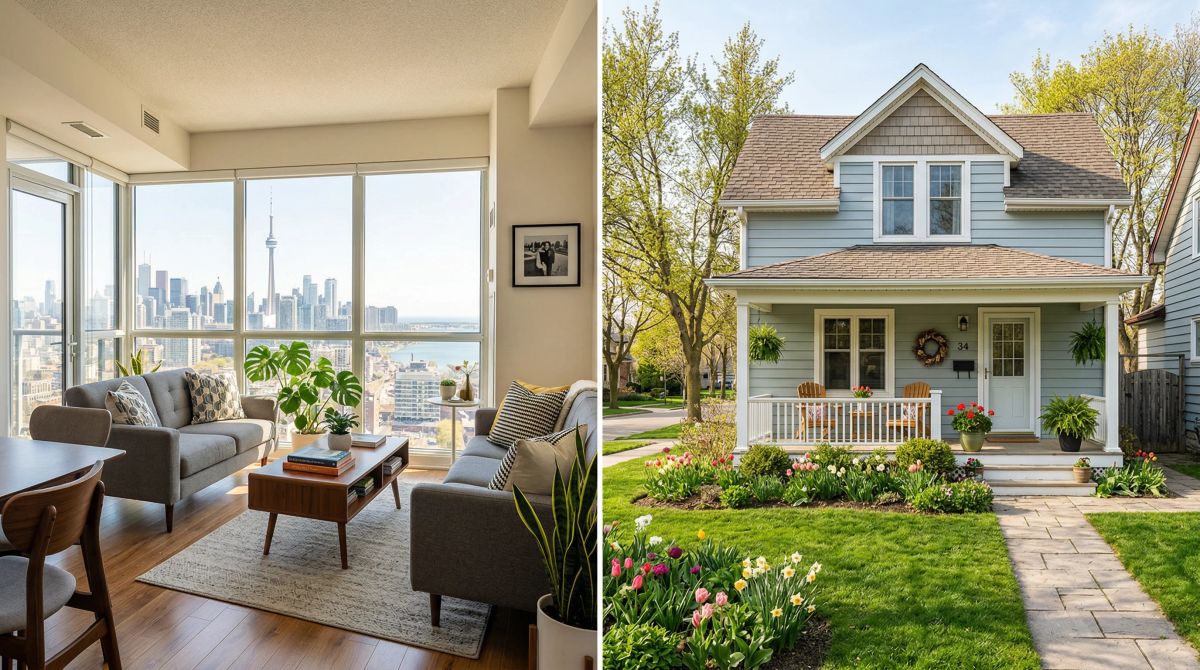
Ontario rents fell 4.7% while home prices dropped 6.7%. With the rent-to-income ratio at 29%, is 2026 the year to keep renting or finally buy? We break it down.
The Equation Has Changed
For the last five years, the rent-vs-buy debate in Ontario had a clear slant: rents were skyrocketing, buying was expensive, and most people just felt stuck. But 2026 has flipped the script in ways that make the decision genuinely complicated.
Ontario rents are falling. Home prices are falling. Mortgage rates are lower than they've been in years, but fixed rates are creeping back up. Canada's population actually declined for the first time since Confederation. And over a million Canadian homeowners are hitting mortgage renewal at higher rates than they signed up for.
So is it smarter to rent in Ontario right now? Or is this the buying opportunity that people will look back on in five years and wish they'd acted on?
The honest answer: it depends on your numbers, your timeline, and your stomach for risk. Let's walk through both sides.
The Current State of Ontario Rents
According to the Rentals.ca March 2026 Rent Report, average asking rents in Canada have fallen for 17 consecutive months, hitting a 33-month low of $2,030 across all property types. Ontario specifically saw rents drop 4.7% year-over-year.
Here's what renters are paying nationally:
| Unit Type | Average Asking Rent (Feb 2026) | Year-over-Year Change |
|---|---|---|
| One-bedroom | $1,781 | -3.5% |
| Two-bedroom | $2,162 | Declining |
| Three-bedroom | $2,486 | +0.6% |
Condo rents fell the hardest — down 5.1% year-over-year — while purpose-built rental apartments dropped a more modest 1.9%. Some GTA suburbs saw double-digit declines: Vaughan rents dropped 11%, Oakville fell 14.6%.
The rent-to-income ratio has improved to 29%, down from 31% a year ago and 34% two years ago. That puts it just below the generally accepted 30% affordability threshold. The income required to afford the average asking rent dropped to $81,213, from $87,728 in 2024.
In practical terms? Renting in Ontario is more affordable than it's been in three years.
The Current State of Ontario Home Prices
On the buying side, Ontario's correction continues. OREA data shows the provincial average home price at $746,900 in February 2026 — down 6.7% year-over-year. The GTA average sits at $1,008,968, down 7.1%.
TD Economics just slashed their Ontario price forecast this week, now predicting a 4% decline for 2026 — reversing their earlier call for a 0.6% gain. Capital Economics went further, warning that Canadian house prices look set to fall for the fifth year running.
The condo market is even softer: Ontario condo prices dropped 8.8% to $496,200, and over 4,500 units are sitting unsold in Toronto alone.
Prices have now fallen 24.4% from the GTA's February 2022 peak of $1,334,544.
The Renting Case: Why Waiting Might Make Sense
Falling rents mean lower opportunity cost
When rents were climbing $200/month every year, renting felt like throwing money into a burning pile. Now that they're declining, the urgency to buy just to "stop wasting money on rent" has genuinely diminished.
If your rent dropped from $2,400 to $2,200 this year, that's $2,400 in annual savings you can redirect toward your down payment fund. And if rents continue to soften through 2026, the calculus keeps improving.
The price floor isn't clear yet
TD Economics explicitly stated that "further price declines may be needed to unlock" sidelined buyers. If that's true, buying today means buying into a still-declining market. A $750,000 purchase that loses another 4% would mean roughly $30,000 in paper losses before you've made your first renovation.
That's not a dealbreaker for someone planning to stay 10+ years, but it stings psychologically, and it erodes your equity cushion.
Mortgage renewals are creating forced sellers
This is the underrated factor in 2026. CMHC data shows that about 60% of all Canadian mortgages — roughly 1.15 million — will renew by the end of 2026. Toronto leads the country in projected mortgage arrears growth. Some pandemic-era buyers are facing payment jumps of 6% to 20%.
That renewal pressure could push more inventory onto the market later this year, giving patient buyers even better selection and pricing power.
Renting flexibility has real value
With the economy uncertain and tariff impacts rippling through Ontario's manufacturing and auto sectors, job security isn't guaranteed for everyone. Renting keeps you mobile. If you need to relocate for work or downsize after a life change, you're not locked into a property that might take 50+ days to sell in the current market.
The Buying Case: Why Acting Now Could Pay Off
You're buying at a 24% discount from the peak
GTA home prices have corrected nearly a quarter from their 2022 highs. For context, the 1989-1996 correction in Toronto saw a similar-sized decline before prices recovered. If history rhymes, buyers who purchase near the bottom of this cycle could see substantial appreciation over the next decade.
Timing the exact bottom is impossible, but you don't need to. You just need to buy at a price that works for your budget and hold long enough for the cycle to turn.
Mortgage rates are genuinely favourable
The best five-year variable rate is 3.35% — the lowest since summer 2022. That's 275 basis points below the 5% peak. Even five-year fixed rates at 3.94%, while ticking up, are historically reasonable.
For a $600,000 mortgage:
| Rate | Monthly Payment (25-yr amortization) | Monthly Payment (30-yr amortization) |
|---|---|---|
| 3.35% variable | $2,934 | $2,638 |
| 3.94% fixed | $3,138 | $2,843 |
| 5.00% (2023 peak) | $3,504 | $3,221 |
That 30-year amortization option is now available to all first-time buyers with insured mortgages — not just new builds — saving roughly $300/month on the same mortgage amount.
First-time buyer programs are stacking up
The combination of programs available to Ontario first-time buyers in 2026 is genuinely powerful. You can now use the FHSA and HBP together for the same home purchase:
| Program | Max per Person | Max per Couple | Key Benefit |
|---|---|---|---|
| FHSA | $40,000 (lifetime) | $80,000 | Tax-deductible in, tax-free out |
| HBP (RRSP) | $60,000 | $120,000 | Tax-free withdrawal, repay over 15 years |
| Federal tax credit | $1,500 | $3,000 | Non-refundable tax credit |
| Ontario LTT rebate | $4,000 | $4,000 | First-time buyers only |
| Toronto MLTT rebate | $4,475 | $4,475 | Toronto purchases only |
A couple who opened FHSAs in 2023 could now have access to $64,000 from their combined FHSAs plus $120,000 from RRSPs — a potential $184,000 in tax-advantaged down payment funds. That's substantial.
Less competition means better deals
With over 100,000 buyers still on the sidelines in the GTA alone, and the sales-to-new-listings ratio sitting around 39% (firmly in buyer's territory), anyone shopping right now faces far less competition than in 2021 or 2022. You can include conditions, negotiate on price, and take your time — luxuries that didn't exist three years ago.
Rent savings aren't building equity
Even with falling rents, every dollar you pay in rent is gone. A mortgage payment, even when prices are declining short-term, is partially building equity through principal repayment. On a $600,000 mortgage at 3.35%, approximately $1,260 of your first monthly payment goes toward principal. That's $15,120 in equity in year one, regardless of what happens to prices.
The Numbers Side by Side
Let's compare a specific scenario: renting a two-bedroom in the GTA vs. buying a $600,000 condo.
| Category | Renting | Buying ($600K, 10% down) |
|---|---|---|
| Monthly payment | $2,162 (avg 2BR rent) | $2,843 (mortgage at 3.94% fixed, 30yr) |
| Condo fees | Included | $500/month |
| Property tax | Included | $350/month |
| Insurance | $50/month (tenant) | $75/month (homeowner) |
| Maintenance reserve | $0 | $250/month |
| Total monthly cost | $2,212 | $4,018 |
| Annual equity built | $0 | ~$13,500 (principal) |
| Down payment required | $0 | $60,000 + $15,000 closing |
The monthly cost difference is roughly $1,800. If you rent and invest that $1,800 monthly difference plus the $75,000 you'd need for a down payment and closing costs, at a 6% average return, you'd have approximately $184,000 after five years.
If you buy and prices recover 3% annually after bottoming in 2027, your $600,000 condo could be worth roughly $660,000 in five years, plus you'd have about $67,500 in mortgage principal paid down — giving you total equity around $127,500 (excluding the down payment).
Pure math? Renting and investing wins in this specific short-term scenario. But the math changes dramatically over 10-15 years, when price appreciation compounds and the mortgage balance shrinks faster.
The Decision Framework
Rather than asking "should I rent or buy?" — ask these five questions:
- How long will you stay? Buying only makes financial sense if you'll hold the property for at least 5-7 years. Less than that, and transaction costs alone (land transfer tax, legal fees, realtor commissions when you sell) eat into any equity you build.
- Is your income stable? In an economy where tariff uncertainty is real and Ontario's job market is softer than other provinces, buying with a variable income or shaky employment is risky. Renting keeps your options open.
- Can you handle a further decline? If prices drop another 4% (TD's forecast), can you mentally and financially handle owning a property worth less than you paid? If that would keep you up at night, it's not the right time for you.
- Are you maximizing the programs? If you haven't opened an FHSA yet, every month you wait is wasted contribution room. Open it now, even if you're not buying for two more years. The tax benefits are too good to leave on the table.
- What does your lifestyle need? Renting offers flexibility. Owning offers stability, customization, and the psychological benefit of "this is mine." Neither is objectively better — it depends on what matters to you right now.
The Bottom Line for Ontario in 2026
There's no universally right answer this year. Falling rents have made renting a better deal than it's been in years. But falling prices and strong buyer programs have also made buying more accessible than at any point since before the pandemic.
The one thing that's certain: doing nothing — not saving, not investing, not opening an FHSA — is the worst option. Whether you rent for another year or buy this spring, make sure your money is working as hard as your decision-making.

Written by
Sara Shao
Contributing writer
Contributing writer on buyer, career, and market explainers published on RealEstateHQ.
View all articles by Sara →

